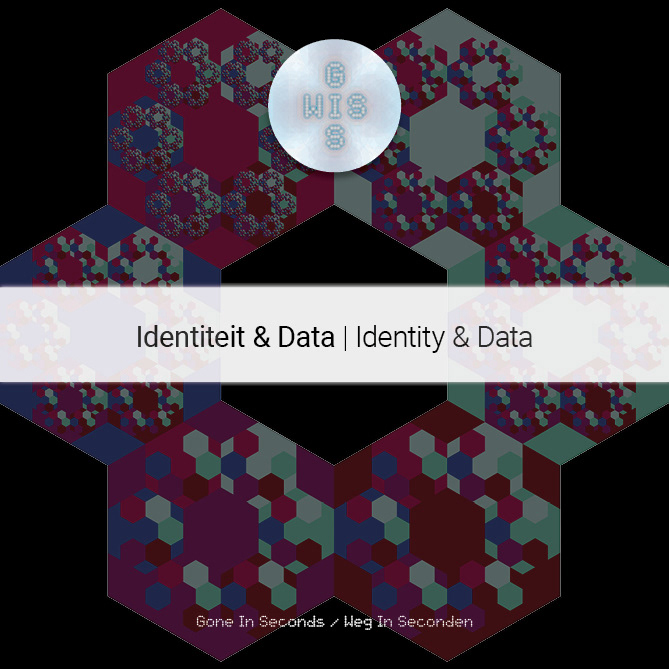
(NL) Identiteit & Data onderzoekt wat er gebeurt wanneer identiteit volledig systeem wordt.
Het hoofdstuk richt zich op de relatie tussen mens en codering, tussen bestaan en verificatie.
Wat persoonlijk lijkt, verschijnt hier als data en structuur.
Projecten zoals Mobiele codes (Google Authenticator, Microsoft Authenticator, Mondial Relay) en Chromatische Identiteit vertalen identiteit naar numerieke en chromatische systemen.
Toegangscodes, geboortedata en relaties worden zichtbaar als kleur en patroon.
Identiteit manifesteert zich als fragmentatie en verbinding tegelijk.
De mens verschijnt als knooppunt binnen een netwerk van systemen.
De data wordt niet geïnterpreteerd maar weergegeven; het beeld ontstaat uit codering.
Controle en toegang bepalen zichtbaarheid en aanwezigheid.
Binnen GIS/WIS brengt dit hoofdstuk het systeem terug naar de mens, zonder sentiment, zonder psychologie — waar identiteit verschijnt als structuur, relatie en tijd.
Het hoofdstuk richt zich op de relatie tussen mens en codering, tussen bestaan en verificatie.
Wat persoonlijk lijkt, verschijnt hier als data en structuur.
Projecten zoals Mobiele codes (Google Authenticator, Microsoft Authenticator, Mondial Relay) en Chromatische Identiteit vertalen identiteit naar numerieke en chromatische systemen.
Toegangscodes, geboortedata en relaties worden zichtbaar als kleur en patroon.
Identiteit manifesteert zich als fragmentatie en verbinding tegelijk.
De mens verschijnt als knooppunt binnen een netwerk van systemen.
De data wordt niet geïnterpreteerd maar weergegeven; het beeld ontstaat uit codering.
Controle en toegang bepalen zichtbaarheid en aanwezigheid.
Binnen GIS/WIS brengt dit hoofdstuk het systeem terug naar de mens, zonder sentiment, zonder psychologie — waar identiteit verschijnt als structuur, relatie en tijd.
Bezoek hier de verzameling van Identiteit & Data
(EN) Identity & Data investigates what happens when identity becomes fully system-based.
The chapter focuses on the relationship between human and code, between existence and verification.
What appears personal is revealed here as data and structure.
Projects such as Access Codes (Google Authenticator, Microsoft Authenticator, Mondial Relay)
and Chromatic Identity translate identity into numerical and chromatic systems.
Access codes, birth dates, and relationships become visible as colour and pattern.
Identity manifests as both fragmentation and connection.
The human appears as a node within a network of systems.
The data is not interpreted but rendered; the image emerges from encoding.
Control and access determine visibility and presence.
Within GIS/WIS, this chapter returns the system to the human, without sentiment, without psychology —
where identity appears as structure, relation, and time.
The chapter focuses on the relationship between human and code, between existence and verification.
What appears personal is revealed here as data and structure.
Projects such as Access Codes (Google Authenticator, Microsoft Authenticator, Mondial Relay)
and Chromatic Identity translate identity into numerical and chromatic systems.
Access codes, birth dates, and relationships become visible as colour and pattern.
Identity manifests as both fragmentation and connection.
The human appears as a node within a network of systems.
The data is not interpreted but rendered; the image emerges from encoding.
Control and access determine visibility and presence.
Within GIS/WIS, this chapter returns the system to the human, without sentiment, without psychology —
where identity appears as structure, relation, and time.
Visit here the collection of Identity & Data