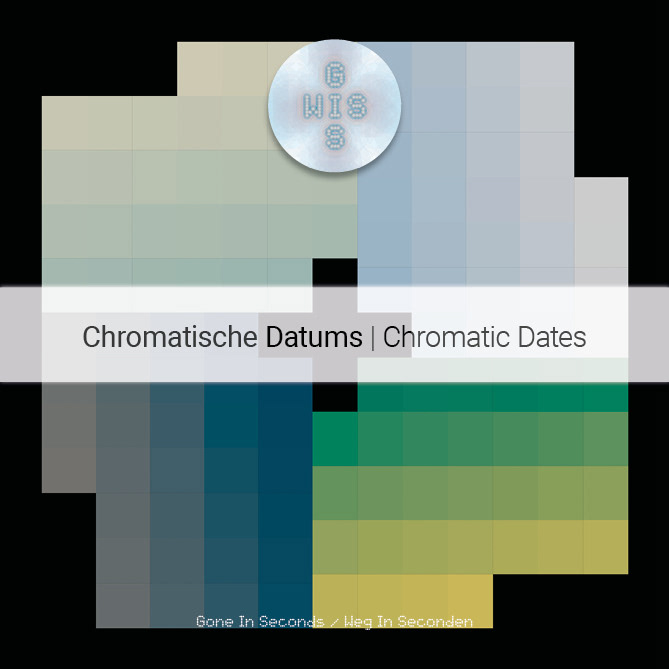
(NL) Chromatische Datums vertaalt datums naar kleur via CMYK-structuren.
Een datum wordt gelezen als numerieke bouwsteen en omgezet in een visueel systeem.
Er worden twee basismethoden gebruikt. De eerste basis bestaat uit dag, maand en jaar (EU), met varianten voor ISO en US, inclusief een percentageversie.
De tweede basis bestaat uit dag, weeknummer, maand en jaar (EU), eveneens met ISO- en US-varianten en een percentageversie.
De tweede basis bestaat uit dag, weeknummer, maand en jaar (EU), eveneens met ISO- en US-varianten en een percentageversie.
Elke methode levert per notatiesysteem 4 kleurwaarden op.
Deze vier kleuren corresponderen met de dagdelen: nacht, ochtend, middag en avond.
Samen vormen EU, ISO en US 12 kleuren per dag.
Omdat elke dag een unieke kleurcombinatie heeft, ontstaat de mogelijkheid tot een vorm van soft time traveling — vooruit en terug in de tijd via kleur.
Zo ontstaat een chromatisch archief waarin tijd verschijnt als ritme, cyclus en ervaring.
Deze vier kleuren corresponderen met de dagdelen: nacht, ochtend, middag en avond.
Samen vormen EU, ISO en US 12 kleuren per dag.
Omdat elke dag een unieke kleurcombinatie heeft, ontstaat de mogelijkheid tot een vorm van soft time traveling — vooruit en terug in de tijd via kleur.
Zo ontstaat een chromatisch archief waarin tijd verschijnt als ritme, cyclus en ervaring.
Bezoek hier de verzameling van In Chromatische Datums
(EN) Chromatic Dates translates dates into colour through CMYK structures.
A date is treated as a numerical building block and converted into a visual system.
A date is treated as a numerical building block and converted into a visual system.
Two basic methods are used. The first basis consists of day, month, and year (EU), with ISO and US variants, including a percentage version.
The second basis consists of day, week number, month, and year (EU), again with ISO and US variants and a percentage version.
The second basis consists of day, week number, month, and year (EU), again with ISO and US variants and a percentage version.
Each method produces 4 colour values per notation system.
These four colours correspond to parts of the day: night, morning, afternoon, and evening.
Together, EU, ISO, and US generate 12 colours per day.
Because each day has a unique chromatic identity, the system allows for a form of soft time traveling — moving forward and backward through time via colour.
The result is a chromatic archive in which time appears as rhythm, cycle, and experience.
These four colours correspond to parts of the day: night, morning, afternoon, and evening.
Together, EU, ISO, and US generate 12 colours per day.
Because each day has a unique chromatic identity, the system allows for a form of soft time traveling — moving forward and backward through time via colour.
The result is a chromatic archive in which time appears as rhythm, cycle, and experience.
Visit here the collection of Chromatic Dates