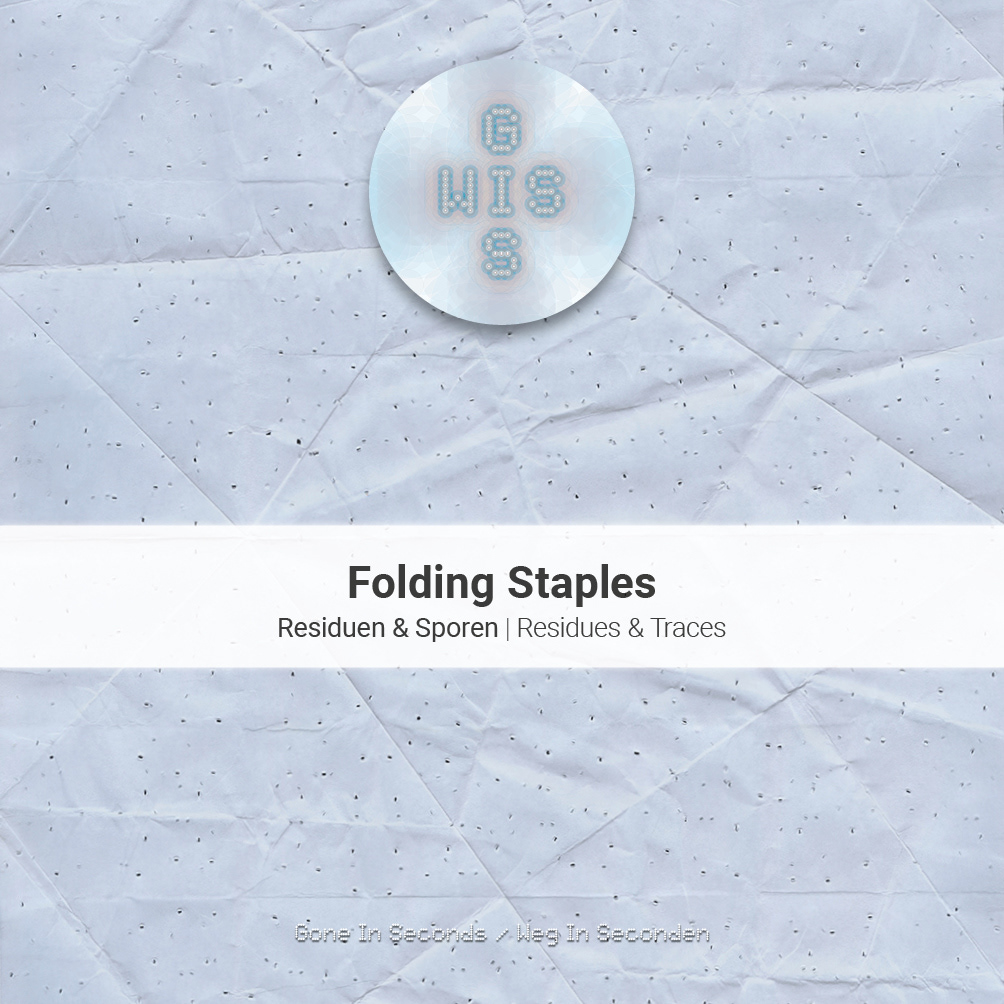
Folding Staples is een visueel onderzoek naar structuur, spanning en het residu van handeling.
Het project vertrekt vanuit gevouwen papier, gefixeerd met nietjes — minimale ingrepen die vorm genereren.
Wat tijdelijk en functioneel is, wordt hier een drager van ritme, patroon en ruimte.
De nietjes markeren punten van fixatie: kleine beslissingen die het geheel structureren.
Door vouwen, herhalen en variëren ontstaan reliëfs die balanceren tussen tekening en object.
Tijd manifesteert zich in kreukels, perforaties en verschuivende spanningen in het oppervlak.
De data wordt niet toegevoegd maar ontstaat uit handeling en materiaal.
Wat een handeling was, wordt systeem; wat fixatie was, wordt compositie.
Binnen GIS/WIS positioneert Folding Staples zich als een residueel archief van gebaar en structuur.
Het werk toont hoe minimale ingrepen kunnen uitgroeien tot een ruimtelijke en esthetische taal.
Het project vertrekt vanuit gevouwen papier, gefixeerd met nietjes — minimale ingrepen die vorm genereren.
Wat tijdelijk en functioneel is, wordt hier een drager van ritme, patroon en ruimte.
De nietjes markeren punten van fixatie: kleine beslissingen die het geheel structureren.
Door vouwen, herhalen en variëren ontstaan reliëfs die balanceren tussen tekening en object.
Tijd manifesteert zich in kreukels, perforaties en verschuivende spanningen in het oppervlak.
De data wordt niet toegevoegd maar ontstaat uit handeling en materiaal.
Wat een handeling was, wordt systeem; wat fixatie was, wordt compositie.
Binnen GIS/WIS positioneert Folding Staples zich als een residueel archief van gebaar en structuur.
Het werk toont hoe minimale ingrepen kunnen uitgroeien tot een ruimtelijke en esthetische taal.
Bezoek hier de verzameling van In Folding Staples
Folding Staples is a visual investigation into structure, tension, and the residue of action.
The project begins with folded paper, fixed by staples — minimal interventions that generate form.
What is temporary and functional becomes a carrier of rhythm, pattern, and space.
The staples mark points of fixation: small decisions that structure the whole.
Through folding, repetition, and variation, reliefs emerge between drawing and object.
Time manifests in creases, perforations, and shifting tensions across the surface.
The data is not added but emerges from gesture and material.
What was an action becomes a system; what was fixation becomes composition.
Within GIS/WIS, Folding Staples positions itself as a residual archive of gesture and structure.
The work reveals how minimal interventions can evolve into a spatial and aesthetic language.
The project begins with folded paper, fixed by staples — minimal interventions that generate form.
What is temporary and functional becomes a carrier of rhythm, pattern, and space.
The staples mark points of fixation: small decisions that structure the whole.
Through folding, repetition, and variation, reliefs emerge between drawing and object.
Time manifests in creases, perforations, and shifting tensions across the surface.
The data is not added but emerges from gesture and material.
What was an action becomes a system; what was fixation becomes composition.
Within GIS/WIS, Folding Staples positions itself as a residual archive of gesture and structure.
The work reveals how minimal interventions can evolve into a spatial and aesthetic language.
Visit here the collection of Chromatic Dates