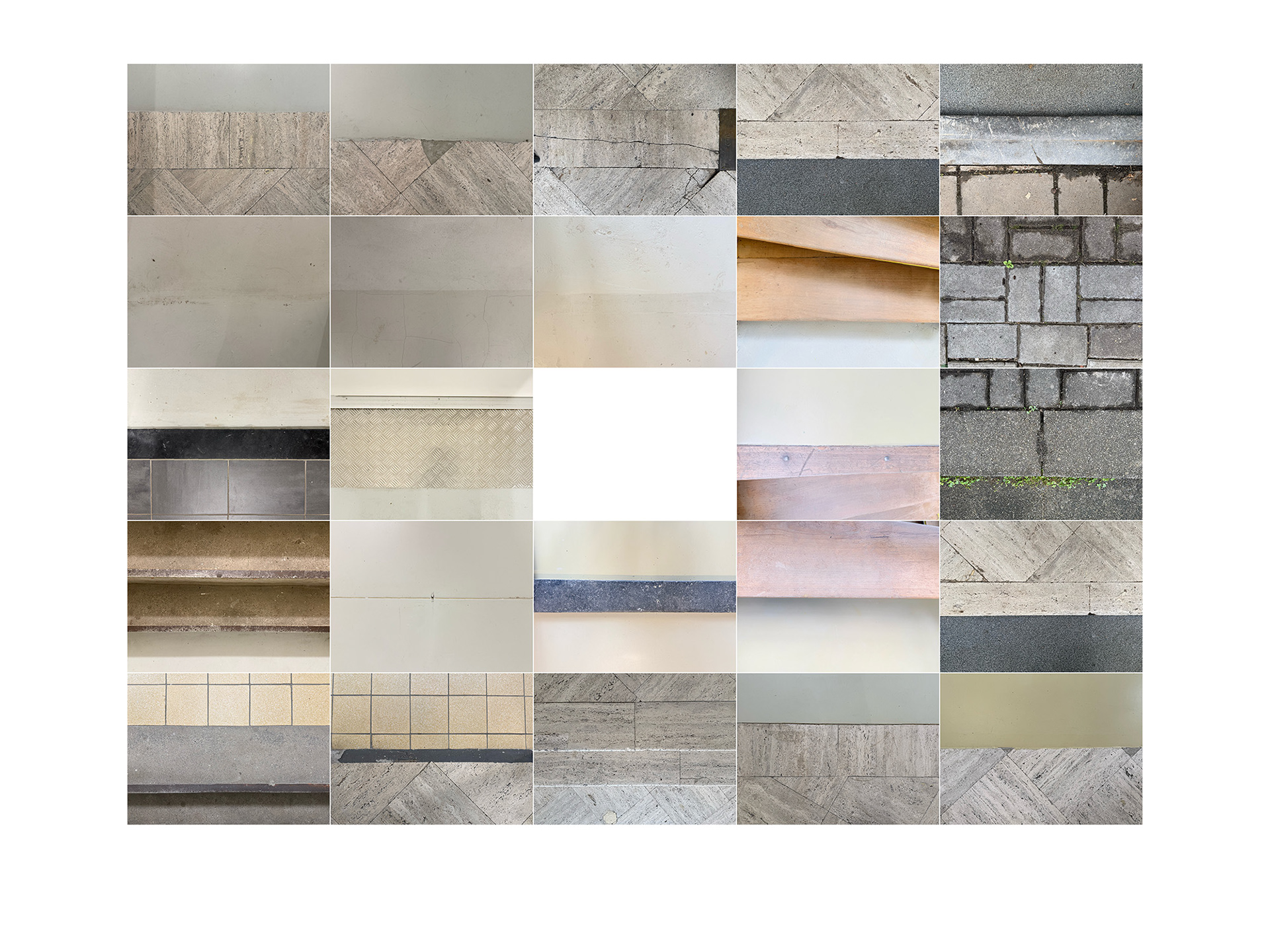
(NL) Institutional Borders is een visueel onderzoek naar overgang, drempel en de passage die de openbare ruimte in zich opneemt. Het project verzamelt grensbeelden van musea — vastgelegd waar materialen elkaar raken: terrazzo en natuursteen, beton en staal, gepolijst en gesleten. Drempels, plintlijnen en vloerovergangen functioneren als sporen van collectieve beweging en gebruik. Wat de institutie nooit toont, verschijnt hier als een structuur van overgangen. Tijd verloopt niet lineair, maar als een opeenstapeling van anonieme passage — duizenden voeten die dezelfde naad oversteken. De beelden komen voort uit het museum zelf: niet uit de collectie, maar uit de grenzen die het trekt en waarop het staat, de oppervlakken die het onderhoudt maar nooit laat zien. De data is niet geconstrueerd maar aangetroffen; het beeld ontstaat uit wat het gebouw prijsgeeft wanneer niemand ernaar kijkt. Elk fragment functioneert als een overgang tussen abstractie en autoriteit, tussen de neutrale vloer en de institutie die erover heerst. Binnen GIS/WIS vormt Institutional Borders een archief van publieke tijd, waarin de drempel de collectie wordt die het museum niet toont — de ruimte zelf, zichtbaar gemaakt als een grens die de institutie trekt.
(EN) Institutional Borders is a visual investigation into transition, threshold, and the passage that public space accumulates. The project collects boundary images of museums — captured where materials meet: terrazzo and stone, concrete and steel, polished and worn. Thresholds, skirting lines, and floor transitions function as traces of collective movement and use. What the institution never exhibits appears here as a structure of transitions. Time does not unfold linearly, but as an accumulation of anonymous passage — thousands of feet crossing the same seam. The images originate from the museum itself: not its collection, but the borders it draws and stands upon, the surfaces it maintains yet never shows. The data is not constructed but encountered; the image emerges from what the building reveals when no one is looking at it. Each fragment functions as a crossing between abstraction and authority, between the neutral floor and the institution that governs it. Within GIS/WIS, Institutional Borders forms an archive of public time, where the threshold becomes the collection the museum does not show — space itself made visible as a border the institution draws.