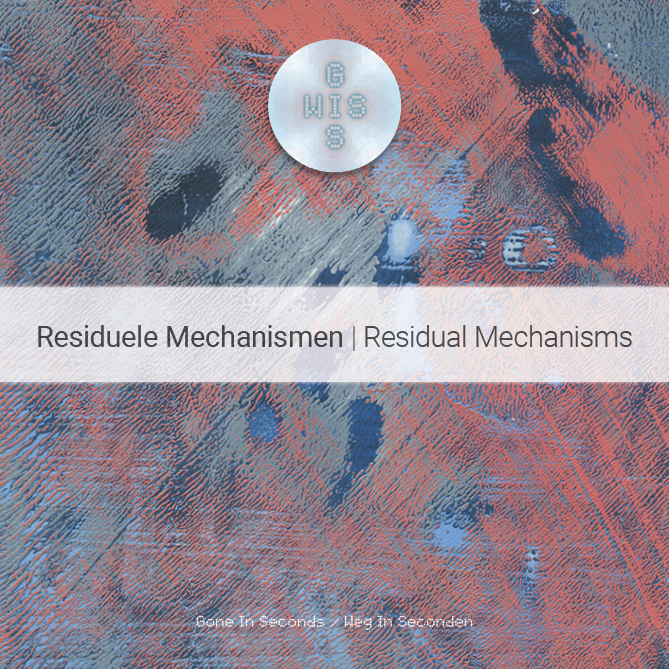
Residuele Mechanismen
(NL) Residuele Mechanismen onderzoekt hoe beeld ontstaat uit wat achterblijft, wordt overgedragen, of bewust wordt aangetast. Binnen Residuele Sporen vormt dit een sublijn waarin drie werken drie verschillende momenten van residuvorming tonen.
De monotypes tonen residu van directe actie: verf, druk en contact laten een eenmalig, niet herhaalbaar spoor achter. Het beeld ontstaat tijdens de handeling zelf, niet erna.
In De Chirico verschuift dit naar overdracht: een reeds geconstrueerd beeld wordt losgelaten en verschijnt opnieuw als afdruk. Hier ontstaat residu niet uit de handeling, maar uit het moment waarop een beeld zijn oorspronkelijke vorm verlaat.
In Self Portrait & Bodoni R Fragment wordt tijd zelf de ingreep: slijtage en verwering worden niet afgewacht, maar toegepast. Wat normaal jaren kost, wordt hier tot handeling gemaakt.
Drie werken, drie mechanismen: handeling, overdracht, tijd.
Telkens ontstaat beeld niet als vastlegging, maar als gevolg — van wat gebeurt, wat wordt doorgegeven, of wat wordt toegevoegd.
Telkens ontstaat beeld niet als vastlegging, maar als gevolg — van wat gebeurt, wat wordt doorgegeven, of wat wordt toegevoegd.
Residuele Mechanismen is dan ook geen serie op zichzelf, maar een manier van kijken naar de andere twee.
Bezoek hier de verzameling van In Residuele Mechanismen
Residual Mechanisms
(EN) Residual Mechanisms explores how image emerges from what remains, is transferred, or is deliberately altered. Within Residues & Traces this forms a sub-line in which three works show three different moments of residue formation.
The monotypes show residue of direct action: paint, pressure, and contact leave a single, unrepeatable trace.
The image emerges during the action itself, not after.
The image emerges during the action itself, not after.
In De Chirico this shifts toward transfer: an already constructed image is released and reappears as an imprint.
Here residue arises not from the action, but from the moment an image departs its original form.
Here residue arises not from the action, but from the moment an image departs its original form.
In Self Portrait & Bodoni R Fragment, time itself becomes the intervention: wear and weathering are not awaited, but applied.
What normally takes years is here turned into an action.
What normally takes years is here turned into an action.
Three works, three mechanisms: action, transfer, time. In each case, image is not the result of fixation, but of consequence — of what happens, what is passed on, or what is added.
Residual Mechanisms is thus not a series in itself, but a way of looking at the other two.
Visit here the collection of Residual Mechanisms